Leo Hickman's article on the current condition of the river Lea shows how little has changed since the rapid period of suburban and industrial expansion into its wetlands and river valley in the nineteenth century.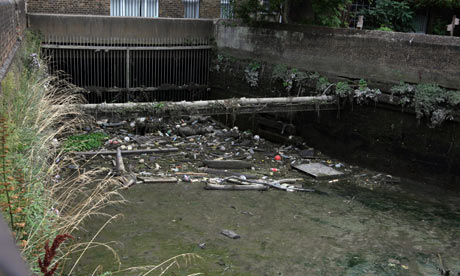 http://www.guardian.co.uk/environment/2009/oct/09/river-lee-polluted-source
Sadly, the problems identified in this article are not new. The pollution of the Lea gained national attention a number of times in the second half of the nineteenth century. In 1855, Alfred Dickens, Charles' brother, investigated the growth of West Ham in the Lower Lea's wetlands and found many of the homes built for workers at the Victoria docks and new industry in Stratford dumped their sewage into marsh drainage ditches connected to the Lea's back rivers. Charles published a newspaper article on the terrible conditions of the Lea's transformed wetlands in 1857: http://apps.newham.gov.uk/History_canningtown/cdickens.htm. In 1866 Cholera hit London and killed a disproportionate amount of people in East London who's water came from the Lea. Two investigations, including a Royal Commission on River Pollution, examined the condition of the Lea and found a growing problem of sewage flowing into the same river people drank from. Unfortunately, the science of pollution and disease remained inconclusive and many people continued to believe sewage became safely oxidized so long as it flowed through running water for a few miles. As a result, the new body created to manage the river and prevent pollution, the Lee Conservancy Board, did not have enough power to force the growing suburbs along the Lea to build an intercepting sewage drain. In 1884, a hot summer and drought brought the river's pollution to national attention once again. One of a series of letters published in the Times in August of that year proclaimed: “The river is now as black as ink. The Stench emitted causes everyone to sicken who inhales it” (Thos. Francis, The Times, Aug 21, 1884). The public uproar led to an extensive investigation by a parliamentary committee. Joseph Bazalgette proposed a comprehensive new sewage system to drain the growing suburbs in the Lea Valley. In the end only a partial solution was implemented, against the famous engineer's public protests, which allowed Tottenham to divert the summer sewage into the London network. At the end of the century, while East London suffered months of intermittent water supply caused by another drought and an inefficient monopoly controlled water system, Stratford had the added problem of heightened levels of sewage in the Channelsea River. This back river flowed past some of Stratford's residential neighborhoods and many important factories. Leyton's and Walthamstow’s population had grown significantly in recent decades resulting in a growing tide of sewage flowing through Stratford. With all of the river water diverted for drinking and transportation, there was nothing left to flush this pollution through the town. These four examples demonstrate how a river once famous for its fishing and fishermen - Izaak Walton - became one of the "ultimate sinks" for London's urban and suburban developments to dump its sewage and industrial waste. It does not seem like we have learned enough lessons from this long history of pollution.
http://www.guardian.co.uk/environment/2009/oct/09/river-lee-polluted-source
Sadly, the problems identified in this article are not new. The pollution of the Lea gained national attention a number of times in the second half of the nineteenth century. In 1855, Alfred Dickens, Charles' brother, investigated the growth of West Ham in the Lower Lea's wetlands and found many of the homes built for workers at the Victoria docks and new industry in Stratford dumped their sewage into marsh drainage ditches connected to the Lea's back rivers. Charles published a newspaper article on the terrible conditions of the Lea's transformed wetlands in 1857: http://apps.newham.gov.uk/History_canningtown/cdickens.htm. In 1866 Cholera hit London and killed a disproportionate amount of people in East London who's water came from the Lea. Two investigations, including a Royal Commission on River Pollution, examined the condition of the Lea and found a growing problem of sewage flowing into the same river people drank from. Unfortunately, the science of pollution and disease remained inconclusive and many people continued to believe sewage became safely oxidized so long as it flowed through running water for a few miles. As a result, the new body created to manage the river and prevent pollution, the Lee Conservancy Board, did not have enough power to force the growing suburbs along the Lea to build an intercepting sewage drain. In 1884, a hot summer and drought brought the river's pollution to national attention once again. One of a series of letters published in the Times in August of that year proclaimed: “The river is now as black as ink. The Stench emitted causes everyone to sicken who inhales it” (Thos. Francis, The Times, Aug 21, 1884). The public uproar led to an extensive investigation by a parliamentary committee. Joseph Bazalgette proposed a comprehensive new sewage system to drain the growing suburbs in the Lea Valley. In the end only a partial solution was implemented, against the famous engineer's public protests, which allowed Tottenham to divert the summer sewage into the London network. At the end of the century, while East London suffered months of intermittent water supply caused by another drought and an inefficient monopoly controlled water system, Stratford had the added problem of heightened levels of sewage in the Channelsea River. This back river flowed past some of Stratford's residential neighborhoods and many important factories. Leyton's and Walthamstow’s population had grown significantly in recent decades resulting in a growing tide of sewage flowing through Stratford. With all of the river water diverted for drinking and transportation, there was nothing left to flush this pollution through the town. These four examples demonstrate how a river once famous for its fishing and fishermen - Izaak Walton - became one of the "ultimate sinks" for London's urban and suburban developments to dump its sewage and industrial waste. It does not seem like we have learned enough lessons from this long history of pollution.

Tags: 2012 Olympics, Channelsea, East London Environment, Environmental History, Jim Clifford, London Rivers, Olympic Environment, Pollution History, River History, River Lea, River Lee, River Pollution, Sewage History, Stratford, Tottenham, Ultimate Sink, West Ham